Free Speech by Timothy Garton Ash
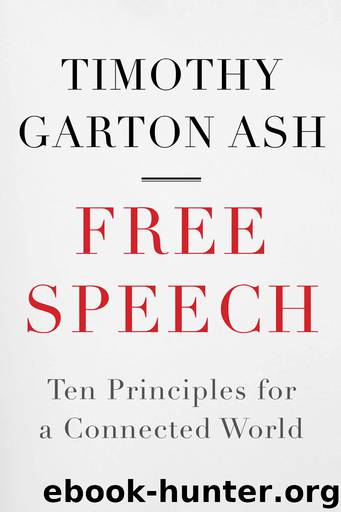
Author:Timothy Garton Ash [Ash, Timothy Garton]
Language: eng
Format: epub
Publisher: Atlantic Books
Published: 2016-05-25T16:00:00+00:00
CIVILITY AND POWER
About six months into our freespeechdebate.com experiment, one of our students said (very civilly) that he did not accept all this civility stuff. He felt that our principles took insufficient account of the drastically unequal power relations in most societies. Civility would only amplify the voice of the powerful, who held the microphone. ‘Those who do well in society’, Sebastian Huempfer argued, ‘cannot feel genuine offence and have no need for violent speech, or shouting, or swearing, or for writing disturbing lyrics and music videos. And they like civility because they define its very meaning’.143
As we have already seen, this identifies a real danger. The president and the pope do not have to shout to make themselves heard. The downtrodden and marginalised are more likely to feel the need to scream and use extreme language. This is one reason why they are often the ones to get prosecuted for hate speech, which only strengthens the case against hate speech laws. But the objection does not have the same force if we understand robust civility as a norm, not a universal, legally binding standard, with potential criminal sanctions. We can then recognise that there will be exceptional circumstances in which there is a case for incivility. Or, even if that case is not persuasive, the fact that a particular group or individual feels repeatedly impelled to resort to such extreme, uncivil language can be seen as a warning signal on the instrument panel of an open society. It could be that this group or individual is just intemperate, extreme or unbalanced, but there may be good reasons why they feel the need to scream, because their voices are not being given a fair hearing in the public sphere.
Another member of our team, Jeff Howard, responded to Sebastian, suggesting that he had not taken sufficient account of the words ‘and able’, which distinguish our first principle from the Covenant’s Article 19.144 Throughout this book I have emphasised that the weak, the few and the persecuted, not just the powerful and the many, must have an effective capacity to make themselves heard. The freedom of which I speak is not the purely notional freedom of the beggar to dine at the Ritz. A society that guarantees free speech on paper but does not give its less powerful members equal and effective voice is only halfway to what free speech should be.
In real life, of course, no society lives up to that ideal, and there are always inequalities of power. At the extreme, in the face of tyranny, these justify not merely incivility but armed resistance. Even Gandhi thought that cowardice in the face of evil was worse than violence in opposing evil.145 Friedrich Schiller describes such moments of last resort magnificently in his play about the Swiss freedom fighter Wilhelm Tell:
No, there are limits to the tyrants’ power.
When a man finds that justice is denied him,
When he can bear no more, then he will look
To Heaven at the last with bold
Download
This site does not store any files on its server. We only index and link to content provided by other sites. Please contact the content providers to delete copyright contents if any and email us, we'll remove relevant links or contents immediately.
The Thirst by Nesbo Jo(7002)
Permanent Record by Edward Snowden(5892)
The Myth of the Strong Leader by Archie Brown(5552)
Spare by Prince Harry The Duke of Sussex(5258)
A Higher Loyalty: Truth, Lies, and Leadership by James Comey(5017)
Secrecy World by Jake Bernstein(4798)
Adulting by Kelly Williams Brown(4622)
The Borden Murders by Sarah Miller(4378)
Machine Learning at Scale with H2O by Gregory Keys | David Whiting(4361)
Killers of the Flower Moon by David Grann(4113)
American Kingpin by Nick Bilton(3931)
The Secret Barrister by The Secret Barrister(3753)
Fear by Bob Woodward(3722)
Future Crimes by Marc Goodman(3630)
The Last Girl by Nadia Murad(3548)
The House on Mango Street by Sandra Cisneros(3509)
Liar's Poker by Michael Lewis(3491)
Oathbringer (The Stormlight Archive, Book 3) by Brandon Sanderson(3312)
The Social Psychology of Inequality by Unknown(3089)
